

Technoethics for Neohumanist Educators
Jareeporn Naksamrit, PhD
Srinakharinwirot University, Thailand
A workshop on this topic was presented at the recent GANE Conference in Romania
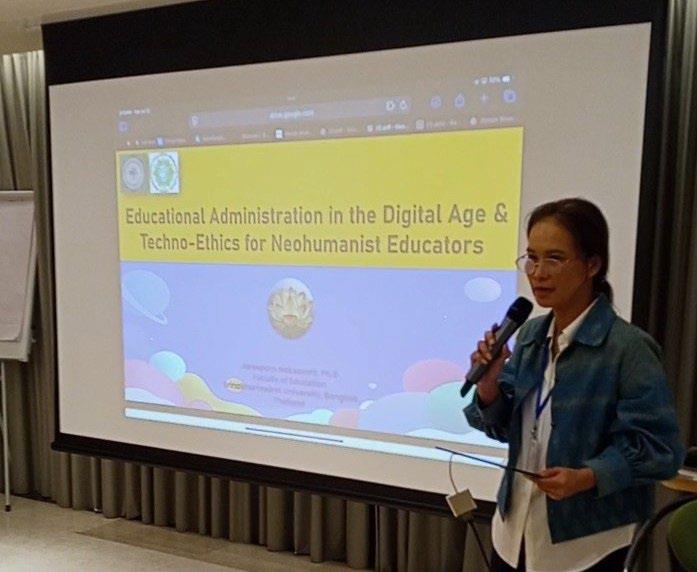 The past two decades have witnessed a digital revolution in education. Digital technology has become an essential learning tool, enabling students to explore virtual realities, multimedia environments, and artificial intelligence (AI). Transforming education requires visionary leadership—school administrators play a central role in designing systems that allow teachers to use AI effectively and responsibly. Technology offers unprecedented opportunities, but also ethical challenges. As AI becomes part of teaching and learning, both educators and students must navigate questions of technoethics—how to use digital tools ethically and in alignment with human values. Neohumanism provides a guiding compass for this process. Its emphasis on holistic development, universal love, social justice, and ecological balance can shape the ethical use of AI.
Educational policies around the world increasingly stress digital literacy and AI skills. For instance, Thailand’s education strategy promotes AI competency from primary through higher education. Students are encouraged to integrate AI in research and communication, yet this rapid digital expansion also exposes inequalities and ethical gaps. While technology offers new pathways for learning, younger children may not yet possess the maturity to manage screen time or understand AI’s influence. In countries such as Sweden, government and parents limit young children’s exposure to digital devices to protect mental and spiritual development. In contrast, Thai children often have unrestricted access to screens—even at night—raising concerns about attention, sleep, and emotional balance. Parents and teachers must therefore cooperate to cultivate healthy, ethical digital habits.
In secondary and higher education, AI introduces new academic integrity challenges. Many students use generative AI tools such as ChatGPT or Gemini to complete assignments without understanding or verifying the content. Teachers may overlook this, allowing students to pass without genuine learning. Such practices weaken students’ analytical thinking and creativity, undermining the human skills education should nurture. Ethical education must therefore emphasize honesty, responsibility, and critical engagement with AI-generated content. Trustworthiness—an essential technoethical value—requires students to verify information, understand its sources, and develop independent insight rather than simply reproducing machine outputs.
As information technology becomes inseparable from human life, the philosophy of Neohumanism is increasingly vital. It calls for using AI and digital tools consciously, guided by ethics, empathy, and awareness. Research shows that digital communication—email, texting, social media—raises new ethical questions about confidentiality, professional boundaries, and competence (Klaus & Hartshorne, 2015). These concerns apply equally to educational contexts. Educators must balance innovation with moral responsibility to ensure that technology enhances, rather than erodes, humanity.
Ethical Dilemmas in Digital Education
Several core ethical issues define the digital age:
- Data Privacy and Security – Who owns and controls student data, and how is it used?
- Algorithmic Bias and Fairness – Do AI systems discriminate or reinforce inequality?
- Digital Equity and Access – Does technology widen the gap between privileged and marginalized learners?
- Screen Time and Well-being – How does continuous exposure affect health and cognitive development?
- Automation vs. Human Interaction – Does technology weaken interpersonal relationships?
- Authenticity and Academic Integrity – How can institutions detect and discourage AI-assisted plagiarism?
- Digital Citizenship and Cyberbullying – How do educators foster responsibility in online behavior?
Technoethics Through a Neohumanist Lens
Technoethics examines whether emerging technologies truly represent progress or create hidden risks. Ethical reflection ensures that innovation aligns with human dignity and social well-being (Zimmer, 2021). Technology aims to solve problems and enhance life, while ethics defines what is right and just. Yet rapid advances—from AI to biotechnology—outpace ethical frameworks. Technoethics encourages restraint when consequences are uncertain. If such discernment had guided early industrial innovations, humanity might have avoided crises like climate change caused by fossil fuel dependence (Heller, 2012). Thus, rigorous ethical scrutiny of new technologies is essential for humanity’s future.
Neohumanist educators play a key role in guiding technological development. Humans—not AI—must lead, applying ethics to every digital endeavor. Education should integrate technoethical principles into curricula to ensure responsible and compassionate technology use. Six Neohumanist principles can inform ethical digital education:
- Universal Love and Inclusivity – Bridge digital divides and foster empathy.
- Holistic Development – Support emotional, social, spiritual, and physical growth.
- Social Justice and Equity – Challenge bias and promote fair data practices.
- Ecological Balance – Address environmental impacts such as e-waste and energy use.
- Intuitive Wisdom and Critical Thinking – Encourage discernment and reflective inquiry.
- Spiritual Growth and Inner Connection – Preserve mindfulness in an increasingly digital world.
Technoethical Leadership in Schools
Ethical leadership ensures technology serves humanity. Technoethical leaders should:
- Model responsible digital behavior.
- Foster critical inquiry about technology’s effects.
- Prioritize student well-being in all technological applications.
- Empower teachers to integrate ethics into digital learning.
- Advocate policies that align educational AI with human values.
Practical Implications and Recommendations
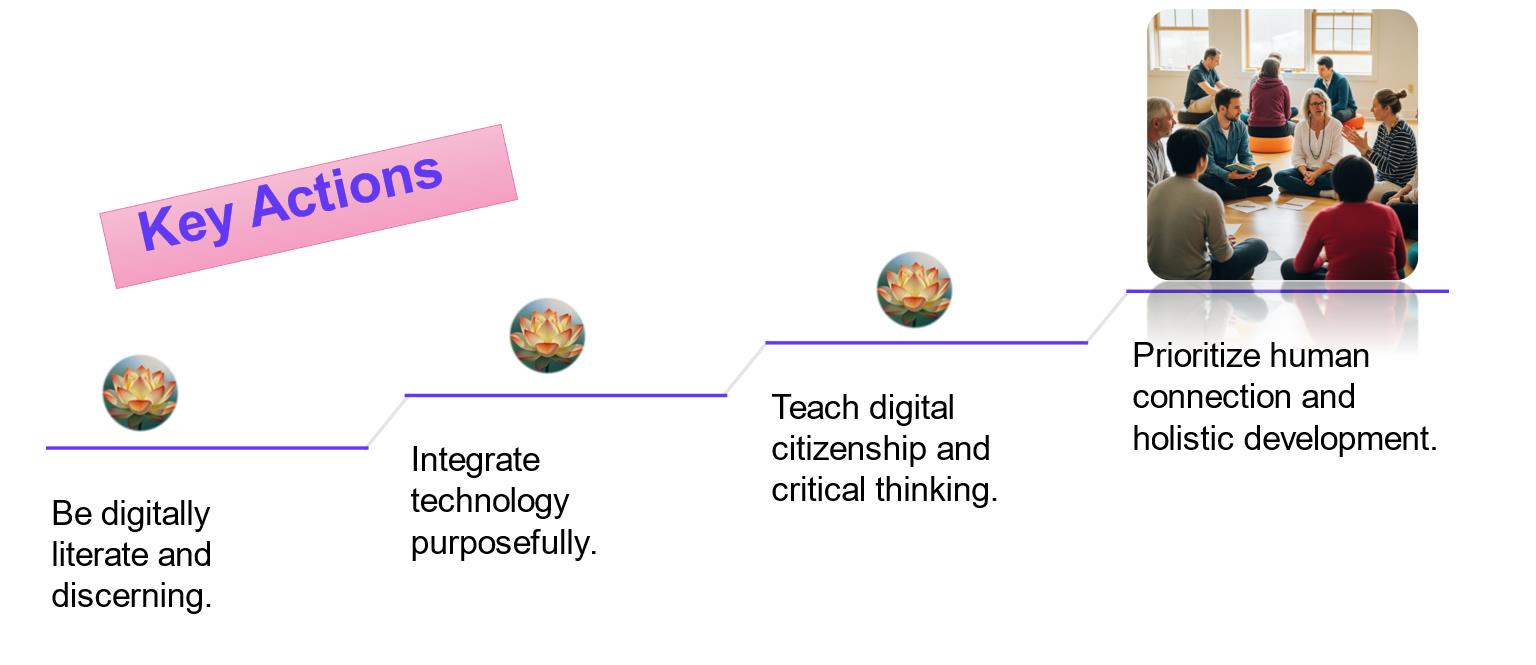
Neohumanist educators can translate these values into practice through the following actions:
- Cultivate digital literacy and discernment, helping students understand both benefits and risks of technology.
- Integrate technology purposefully, using digital tools to enhance—not replace—human connection.
- Teach digital citizenship and critical thinking, promoting ethical decision-making online.
- Prioritize holistic development, recognizing emotional and spiritual needs alongside technical skills.
Education must continually question what technology does to humanity and how ethical reflection can shape its use (Dorrestijn, 2017).
Harnessing Technology for Humanity
Neohumanist education views AI as a spiritual opportunity rather than a threat. Human consciousness must guide AI, not the reverse. Administrators and policymakers should envision systems that merge digital innovation with ethical awareness, creating education that is both technologically advanced and deeply humane.
Neohumanist Education for the Future
A Neohumanist approach envisions a society grounded in universal love, justice, and ecological harmony. Technology must serve these aims, helping to build a happy, sustainable, and compassionate world. Education should nurture both technological competence and inner wisdom, preparing individuals to act ethically and responsibly in the digital age.
Conclusion
Digital technology and AI expand humanity’s capacity for learning and creativity, yet they demand mindfulness and moral discernment. Following P. R. Sarkar’s Neo-humanist philosophy (1982), education must move beyond knowledge transmission toward holistic human development. By integrating Neohumanist principles—universalism, ethical awareness, and spiritual growth—educators can ensure that technology serves humanity rather than dominates it. As Ghosh, Shinde, and Sarkar (2025) affirm, Neo-humanism provides a framework for inclusive, value-based education that fosters compassion, social consciousness, and wisdom in the digital era.
References
- Dorrestijn, S. (2017). The care of our hybrid selves: Ethics in times of technical mediation. Foundations of Science. 22(2), 311–321.
- Ghosh, S., Shinde, D., Sarkar, R. (2025). Prabhat Ranjan Sarkar’s Neo-humanism: A Framework for Inclusive and Value-based Education. Asian Journal of Education and Social Studies. 51(1), 337-343.
- Heller, P. B. (2012). Technoethics: The dilemma of doing the right moral thing in technology applications. International Journal of Technoethics, 3(1), 14–27.
- Kaur, R. (2011). Inclusive education: A Neohumanist approach. Journal of Education and Practice, 2(3), 22-30.
- Klaus, C. L., & Hartshorne, T. S. (2015). Ethical implications of trends in technology. The Journal of Individual Psychology, 71(2), 195–204. https://doi.org/10.1353/jip.2015.0012
- Sarkar, P. R. (1982). Neo-humanism: The liberation of intellect. Ananda Marga Publications.
- Sarkar, P. R. (1999). Neo-humanism: A vision of the future. Proutist Universal.
- Shambhushivananda. (2018). Thoughts for a New Era: A Neohumanist Perspective. Gurukula Press.
- Zimmer, Scott, JD. (2020). Technoethics and Society. https://www.ebsco.com/research- starters/technology/technoethics-and-society#full-article