

By Pradeepti Gusain
Flow experiences occur when we become engaged in controllable but challenging tasks or activities that require considerable skill and which are intrinsically motivating. These tasks require total concentration so we become deeply and effortlessly involved in them, so much so that we no longer think of the worries and frustrations of everyday life. Our sense of self disappears when involved in these tasks and paradoxically the sense of self emerges as strengthened after the task is completed. Time perception is altered during flow experiences.
As a dancer for nearly a decade now, experiencing flow state through dance has become a common occurrence for me. Whether it be during practice or even on stage, in front of the big bright lights, with loud music and hundreds of eyes on me. Over the past week while doing this activity I noticed not only how engrossed I was in the activity but also how as soon as I thought about the activity at hand, my flow state was broken. I do not consider this negatively but I’m pleasantly surprised at how I could lose my sense of self and how even my consciousness was altered while dancing.
Behaviourally too, more often than not I have noticed feelings of euphoria after being on stage and giving a good performance. Even though I know I am being actively judged and my skill being questioned, there is truly nothing more exciting than being on stage, showcasing my art, getting lost in the moment and the ego boost I get from knowing everyone is looking at me. Though all these cons exist about being on stage, I reach flow state there as well. Contrary to what actual flow means, I believe a stage provides an avenue to reach flow state.
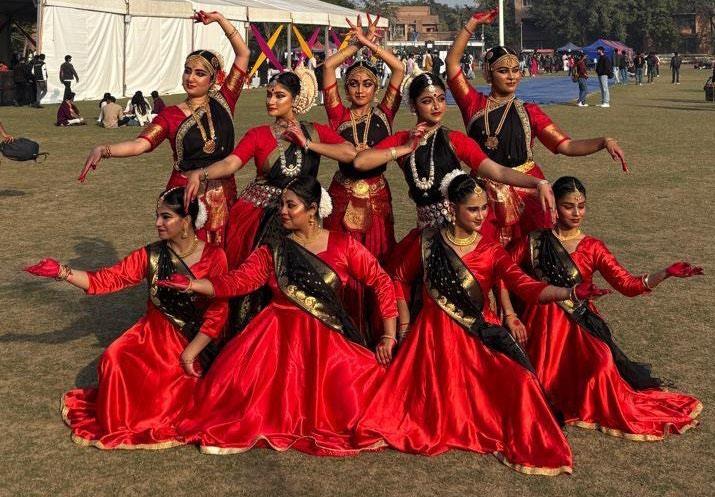
If I critically analyze my experience from the point of view of various topics in Positive Psychology, I think the first thing that comes to my mind is spirituality. Indian classical dance has many songs dedicated to Hindu Gods and Goddesses. Though I wouldn’t consider myself a religious person, devoting a dance piece of my art form to God has truly brought me inner peace. I believe in the power of God because of such pieces and how elaborately they describe His looks, His deeds and His strengths. His portrayal in these pieces is beautiful and while performing one truly becomes a devotee, lost in memory and sometimes even feels as though He has truly materialized and has graced us with His presence. For example, in songs of Shiva Ji or Kaali Maa, the attire is louder with red and black being used to show their fury and bigger eye makeup is done. The focus is on pure nritta (dance steps) more than abhinaya (expressions) but the dominant abhinaya is of anger, fury and their strength to destroy demons. Another example is that of Shri Krishna, where mostly blue and green are worn to depict his complexion and a peacock feather is placed on the head. The focus is on abhinaya of peace, joy, childhood mischief and of flirting with the Gopis. One truly starts to feel as though the God being depicted is within us, with their characteristics assimilating side-by-side to ours and them existing among mortals using you as a portal.
self-awareness.
Coming from a privileged enough background that I can pursue extracurricular activities without thinking twice, I also want to highlight how as a society we take so much pride in our culture but actively discourage the advancement of this very culture by telling young, budding dancers that their academics are first then their art form. There is no list to what one loves, both academics and extracurriculars can co-exist. One must not choose. Imagine only if we told the best dancers and musicians of the world that their art wasn’t worth pursuing!
Lastly, I believe the most important thing I have gained from dance is not resilience, flow, spirituality or creative advancement, but the social relationships I have made along the way. I am someone who invests a lot into my social relationships because of the advantages they provide me. Even through dance, I have made some of my best friends and have met people with amazing mindsets that I wouldn’t normally have. Dance has granted me relationships that have enriched my life for the better and I shall cherish. Even experiencing flow states in a group and having that feeling of euphoria as a community is unmatched and truly a once in a lifetime experience.
In conclusion, this experience showed me how dance helps me to enter a flow state that enhances both my well-being and my sense of self. Despite moments of fatigue and doubt, the joy, immersion, and connection I felt made the process meaningful. Dance is not just an activity for me, but a powerful source of expression, growth, and belonging.
References
American Psychological Association. (2020). Publication manual of the American Psychological Association (7th ed.). American Psychological Association.